Smart manufacturing demands precision, speed, and consistent quality across every unit. Industries such as electronics, home appliances, and EV battery production require structured workflows that deliver reliable output. Smart automated assembly lines bring all processes into a connected system that ensures accuracy and scalability across production environments.
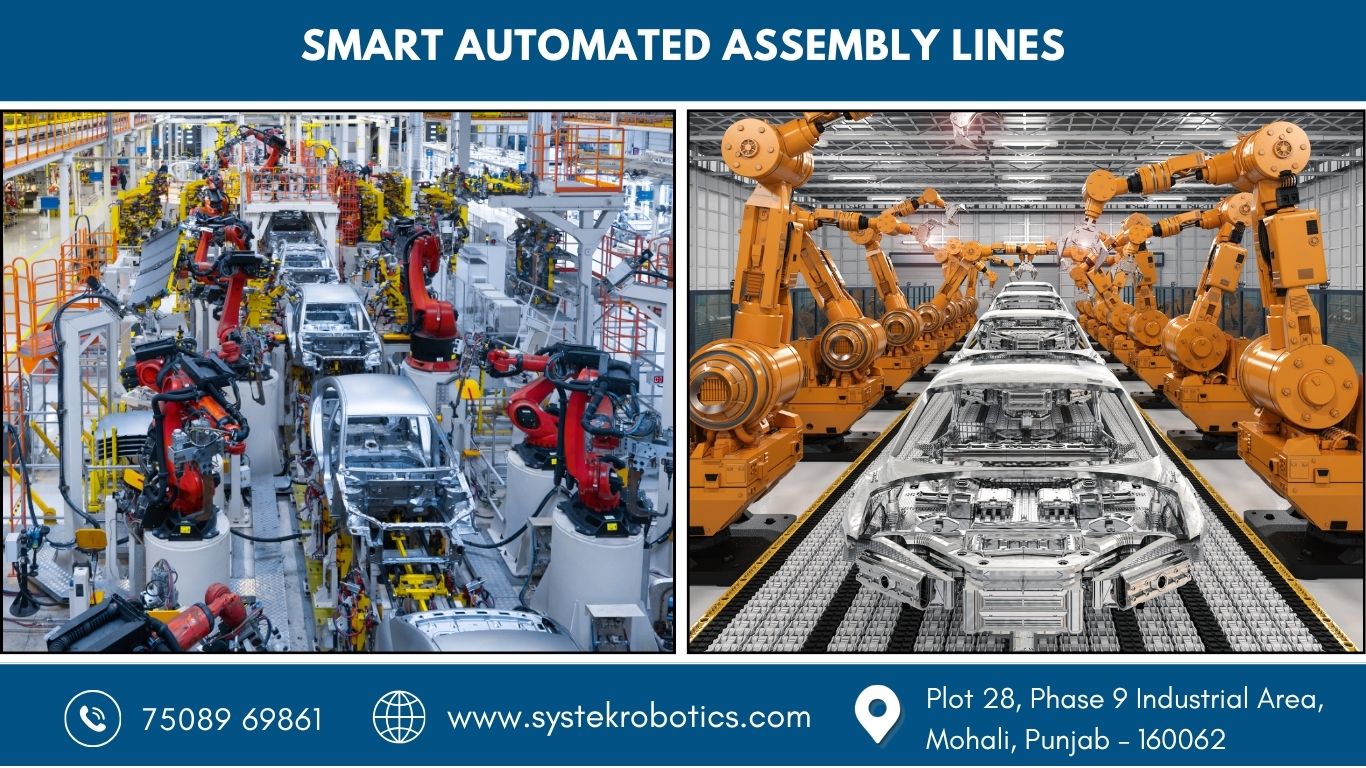
An automated assembly line uses robotics, conveyors, sensors, and control systems to assemble products in a defined sequence. Each station performs a specific task such as component placement, fastening, inspection, or testing. Materials move automatically from one stage to another, which ensures smooth workflow and consistent production output.
These systems rely on real-time monitoring and intelligent controls to maintain accuracy. Engineers design each line based on product requirements, cycle time, and production volume.
Manufacturing leaders focus on improving efficiency and maintaining product quality across high-volume production. Manual assembly creates variation and limits output consistency. Automation removes these limitations by delivering precise and repeatable operations.
Automated assembly lines ensure continuous production and reduce dependency on manual labour. They also support real-time tracking of production performance, which helps teams identify issues and maintain control over quality.
Industries adopt automation to achieve better process stability and meet growing market demand.
Manufacturers choose automation types based on production needs and product complexity.
Fixed systems support high-volume production with consistent product design. These setups deliver fast and stable performance for large-scale manufacturing.
Programmable systems allow adjustments for different product batches. Engineers can update programs to handle design changes without major modifications.
Flexible systems support multiple product types and quick changeovers. These setups suit industries with frequent product updates and varied production requirements.
Each type offers a structured approach to improve efficiency and maintain consistent output.
Smart assembly lines deliver strong advantages across production operations.
Robotic systems perform tasks with precision and reduce defects.
Automation ensures continuous workflow and reduces cycle time.
Modular designs support expansion based on production demand.
Sensors and control systems track performance and maintain quality.
Automation reduces rework, minimises waste, and improves resource utilisation.
These benefits help industries maintain competitive performance and achieve reliable output.
Smart automated assembly lines support multiple industries that require high precision and efficiency.
These systems adapt to different production needs while maintaining consistent quality and performance.
Electronics, automotive, appliances, and EV battery manufacturing use these systems to improve efficiency and quality.
They ensure consistent operations, reduce manual errors, and maintain steady workflow across production stages.
Flexible automation allows handling of different product types with quick adjustments.
Robotics, sensors, vision systems, conveyors, and PLC-based controls manage operations.
Modular design allows easy expansion based on production requirements.
Smart automated assembly lines create efficient and scalable production environments. These systems improve accuracy, maintain consistent output, and support high-speed manufacturing across industries.
Systek Robotics delivers advanced assembly automation solutions tailored to your production needs. Contact us today to implement smart automated assembly lines and achieve reliable, high-performance manufacturing.