Manufacturing industries need fast production, accurate welding, and consistent fabrication quality to stay competitive. Manual welding often creates uneven welds, slower production speed, and higher operational costs. Robotic welding systems solve these problems through precision, repeatability, and automated control.
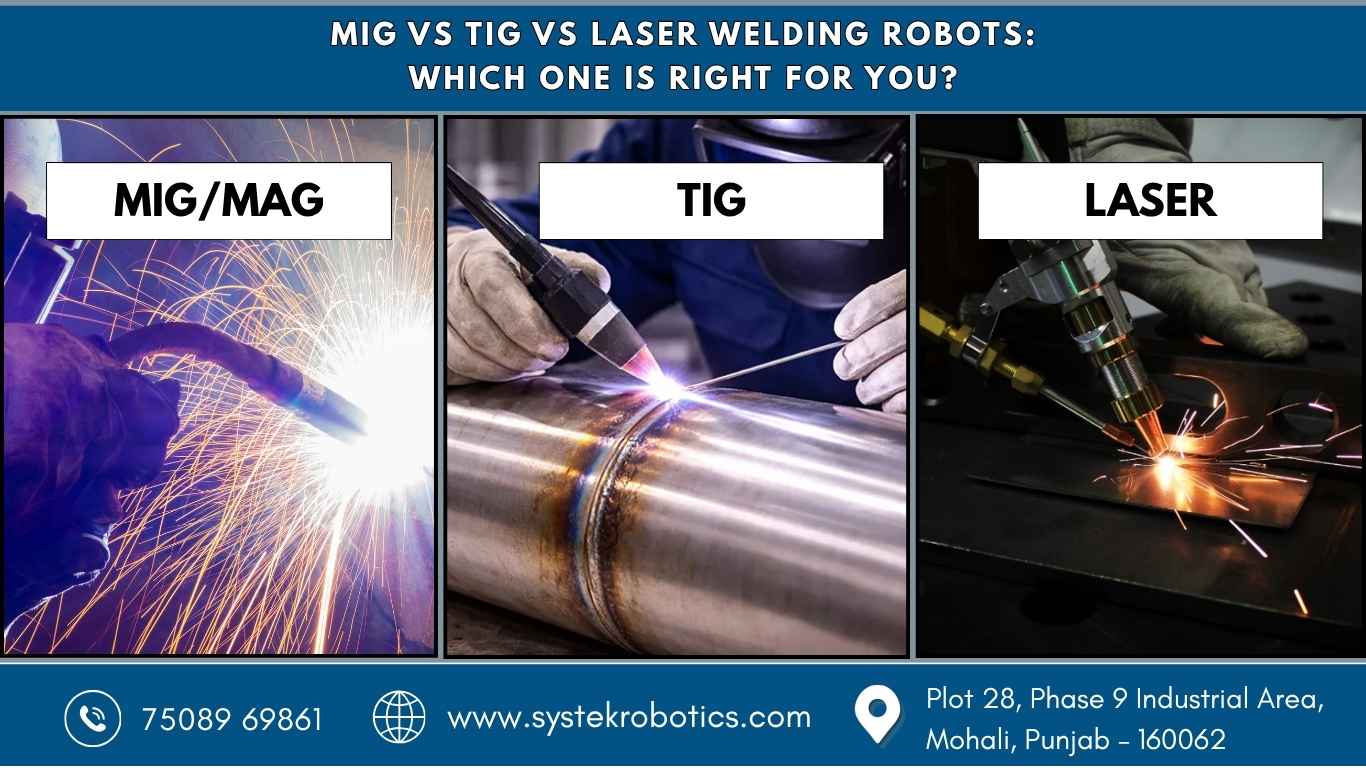
Many manufacturers struggle to choose the right welding robot because every welding process works differently. MIG, TIG, and laser welding robots each serve specific industrial applications. The right choice depends on your product type, material thickness, production volume, and quality expectations.
Understanding the difference between these automated robotic welding technologies helps manufacturers invest in the right automation system for long-term production efficiency.
Welding robots are automated robotic systems that perform welding operations through programmed movement and intelligent controls. These systems improve weld quality, reduce manual effort, and support continuous production across industrial environments.
Manufacturers use robotic welding systems for:
Robotic welding systems maintain stable welding quality during repetitive production tasks and improve operational efficiency across manufacturing lines.
MIG welding stands for Metal Inert Gas welding. MIG welding robots use a continuously fed wire electrode to join metal components through electric arc welding.
These robots work best for high-speed industrial welding applications that require strong weld joints and faster production output.
MIG welding robots complete welding operations quickly and support high-volume production.
Manufacturers achieve faster fabrication cycles and improved workflow efficiency.
MIG welding systems integrate easily with robotic automation lines.
These robots handle thicker metals efficiently across industrial applications.
Manufacturers commonly use MIG welding robots in:
MIG welding may create more spatter during welding operations. These systems also require clean welding surfaces for better results.
TIG welding stands for Tungsten Inert Gas welding. TIG welding robots use a non-consumable tungsten electrode to create highly precise welds with clean finishing.
These robotic systems work best for applications that require detailed welding and premium surface quality.
TIG welding robots produce accurate and smooth weld joints.
Manufacturers achieve better visual appearance and cleaner weld surfaces.
These systems provide excellent control during delicate welding operations.
TIG welding works efficiently on stainless steel, aluminium, and thin sheet metal.
Industries commonly use TIG welding robots in:
TIG welding operates slower than MIG welding. These systems may also increase production cost for high-volume applications.
Laser welding robots use concentrated laser beams to join metal components with extreme precision and minimal heat impact.
These systems support high-speed and high-accuracy welding applications across advanced manufacturing industries.
Laser welding robots create fine and accurate weld joints.
These systems reduce material warping during welding operations.
Laser welding supports rapid production across automated manufacturing lines.
Manufacturers use laser welding for small and detailed industrial parts.
Laser welding robots work well in:
Laser welding systems require higher initial investment and advanced automation setup.
| Feature | MIG Welding Robot | TIG Welding Robot | Laser Welding Robot |
|---|---|---|---|
| Welding Speed | High | Medium | Very High |
| Precision | Good | Excellent | Extremely High |
| Material Thickness | Thick Materials | Thin Materials | Thin to Medium |
| Weld Appearance | Moderate | Premium Finish | Clean and Precise |
| Automation Suitability | Excellent | Good | Advanced Automation |
| Production Volume | High Volume | Medium Volume | High Precision Production |
| Initial Cost | Moderate | Moderate | High |
The right welding robot depends on your manufacturing requirements and production goals.
Manufacturers should evaluate several factors before investing in robotic welding systems.
Large-scale production facilities often require faster welding technologies.
Different welding systems work better for different metals and thickness levels.
High-end products often require cleaner and more precise welding results.
Laser welding systems require higher investment compared to MIG and TIG systems.
Manufacturers should choose scalable robotic systems that support future production growth.
Robotic welding systems improve manufacturing efficiency and operational control across industrial environments. These systems reduce manual dependency, improve weld consistency, and support continuous production.
Manufacturers achieve:
Industries that invest in robotic welding automation build smarter and more efficient manufacturing environments.
Choosing the right welding robot directly impacts production efficiency, fabrication quality, and long-term operational performance. MIG, TIG, and laser welding robots each deliver unique advantages based on industrial application requirements.
Systek Robotics delivers advanced robotic welding automation solutions designed for modern manufacturing industries. Our automation experts develop customised welding systems that improve precision, productivity, and workflow efficiency across industrial operations. Contact Systek Robotics today to upgrade your manufacturing process with advanced robotic welding automation solutions.