Modern manufacturing depends on speed, precision, and consistent workflow. Industries no longer rely only on manual handling because repetitive movement slows production and increases operational costs. Companies now invest in robotic automation to improve productivity and maintain product quality across production lines. A pick and place robot plays a major role in this transformation because it automates repetitive handling tasks with high accuracy and stable performance.
Industries such as automotive, electronics, packaging, pharmaceuticals, food processing, and logistics use pick and place robots to improve production efficiency and reduce manual effort. These robotic systems help manufacturers maintain faster cycle time, better product handling, and continuous workflow across industrial operations.
Systek Robotics develops advanced robotic automation systems that support smart manufacturing and efficient material handling solutions for modern industries.
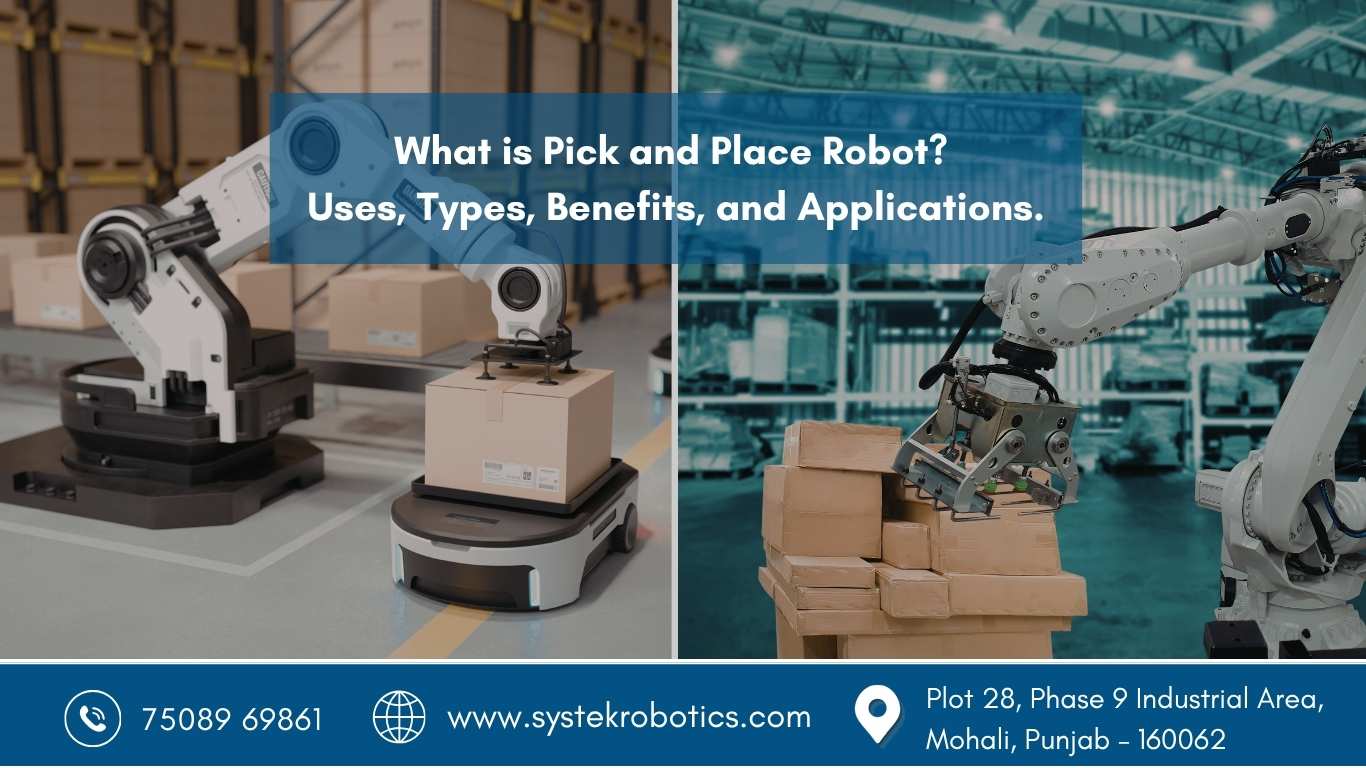
A pick and place robot is an industrial robotic system that picks products, components, or materials from one location and places them into another location automatically. These robots perform repetitive handling tasks with speed, accuracy, and controlled movement.
Manufacturers use pick and place robots for sorting, packaging, assembly, palletizing, inspection, machine loading, and product transfer operations. These systems improve handling precision and maintain continuous production output across manufacturing environments.
Factories use robotic handling systems because they reduce manual dependency and support high-volume production with reliable performance.
Pick and place robots operate through programmed instructions and intelligent motion control systems. The robotic process starts when sensors or vision systems identify the product location.
The robotic arm moves toward the object using programmed coordinates. The end effector grips the product securely based on product shape, size, and weight. After gripping the product, the robot transfers it to the target position and places it accurately according to the programmed path.
Modern robots complete this process within seconds. Advanced systems also use AI vision technology, sensors, and machine learning algorithms to improve positioning accuracy and handling precision.
Many manufacturing facilities integrate these robots with conveyors, CNC machines, assembly stations, and inspection systems to create a fully automated workflow.
Different industries require different robotic structures based on speed, payload capacity, flexibility, and application type.
Cartesian robots move along straight linear axes. These robots provide excellent positioning accuracy for applications that require controlled linear movement.
Industries use Cartesian robots for:
SCARA robots deliver high-speed horizontal movement and excellent repeatability. Electronics manufacturers commonly use these robots for lightweight handling tasks.
SCARA robots perform well in:
Delta robots operate at extremely high speed. Their lightweight parallel arm structure allows fast movement across conveyors.
Industries use delta robots for:
Articulated robots contain multiple rotating joints that support flexible movement. These robots handle complex industrial applications and heavy payloads.
Industries use articulated robots for:
Collaborative robots, also known as cobots, work safely near human operators. Small manufacturing facilities often use these robots for flexible automation.
Cobots support:
Every pick and place system is built from a combination of mechanical and digital components working together. Knowing what each part does helps you ask the right questions when evaluating a system.
The arm is the mechanical backbone. Its design – whether cartesian, delta, or articulated – determines the robot’s range of motion, speed, and workspace coverage.
This is the hand of the robot. Suction cups work well for flat, smooth surfaces. Mechanical grippers handle irregular or textured objects. Soft robotic grippers are emerging as an option for fragile items like food or glass.
Cameras and sensors give the robot its eyes. A 2D vision system captures flat images; a 3D vision system builds depth maps, allowing the robot to handle objects in random orientations. Vision systems are now a near-standard feature on flexible pick and place lines.
The controller is the robot’s brain. It processes sensor data, runs the motion-planning algorithms, and sends precise commands to the motors. Most modern controllers support integration with PLCs, MES systems, and cloud-based monitoring platforms.
Pick and place robots rarely work in isolation. They typically pair with infeed conveyors, rotary tables, bowl feeders, or vibratory feeders that present objects at consistent intervals.
Industrial robots need safety fencing, light curtains, or collaborative safety modes to protect nearby workers. Regulatory compliance (ISO 10218, ISO/TS 15066 for cobots) is non-negotiable in professional installations.
Pick and place robots support multiple industrial applications because they handle repetitive movement tasks efficiently.
Packaging companies use robots for carton loading, sorting, labeling, and product arrangement.
Automotive manufacturers use robotic systems for component transfer, assembly support, and machine loading operations.
Electronics industries use pick and place robots to handle delicate components with high precision.
Food processing facilities use robots for tray loading, sorting, packaging, and product placement.
Pharmaceutical manufacturers use robotic handling systems for medicine packaging and product inspection applications.
Warehouses use robotic automation for order fulfilment, sorting, palletizing, and inventory handling.
Pick and place robots provide several operational advantages for manufacturers.
Robots perform repetitive tasks continuously without production delays.
Robotic systems reduce handling errors and maintain precise product placement.
Automation lowers manual workload across production environments.
Robots reduce repetitive lifting and risky handling tasks.
Robotic systems maintain stable performance across long production cycles.
Manufacturers reduce wastage, rework, and production downtime through robotic automation.
Manufacturers should evaluate operational requirements carefully before selecting a robotic system.
The robot should handle product weight safely and efficiently.
High-speed operations require robots with faster cycle time and motion control.
Factory layout affects robot reach, installation area, and movement flexibility.
Different tasks require different robotic configurations and gripper designs.
Manufacturers should choose scalable robotic systems that support future production growth.
Pick and place robot pricing depends on several factors such as robot type, payload capacity, automation complexity, software integration, and vision technology.
Basic robotic systems for lightweight handling applications cost less than advanced robotic cells with AI vision systems, conveyors, and high-speed automation capabilities.
Manufacturers should evaluate long-term productivity benefits instead of focusing only on initial investment costs. Robotic automation improves operational efficiency, production speed, and workflow consistency over time.
Modern industries require automation systems that deliver speed, precision, and long-term operational reliability. Pick and place robots help manufacturers automate repetitive handling tasks while improving production performance across industrial applications.
Systek Robotics provides customised robotic automation systems designed for packaging, assembly, palletizing, machine tending, and material handling operations. Our team develops smart robotic solutions that help manufacturers improve productivity, reduce operational costs, and build efficient manufacturing environments. Contact Systek Robotics today to upgrade your factory with advanced pick and place robotic automation solutions.